TL;DR
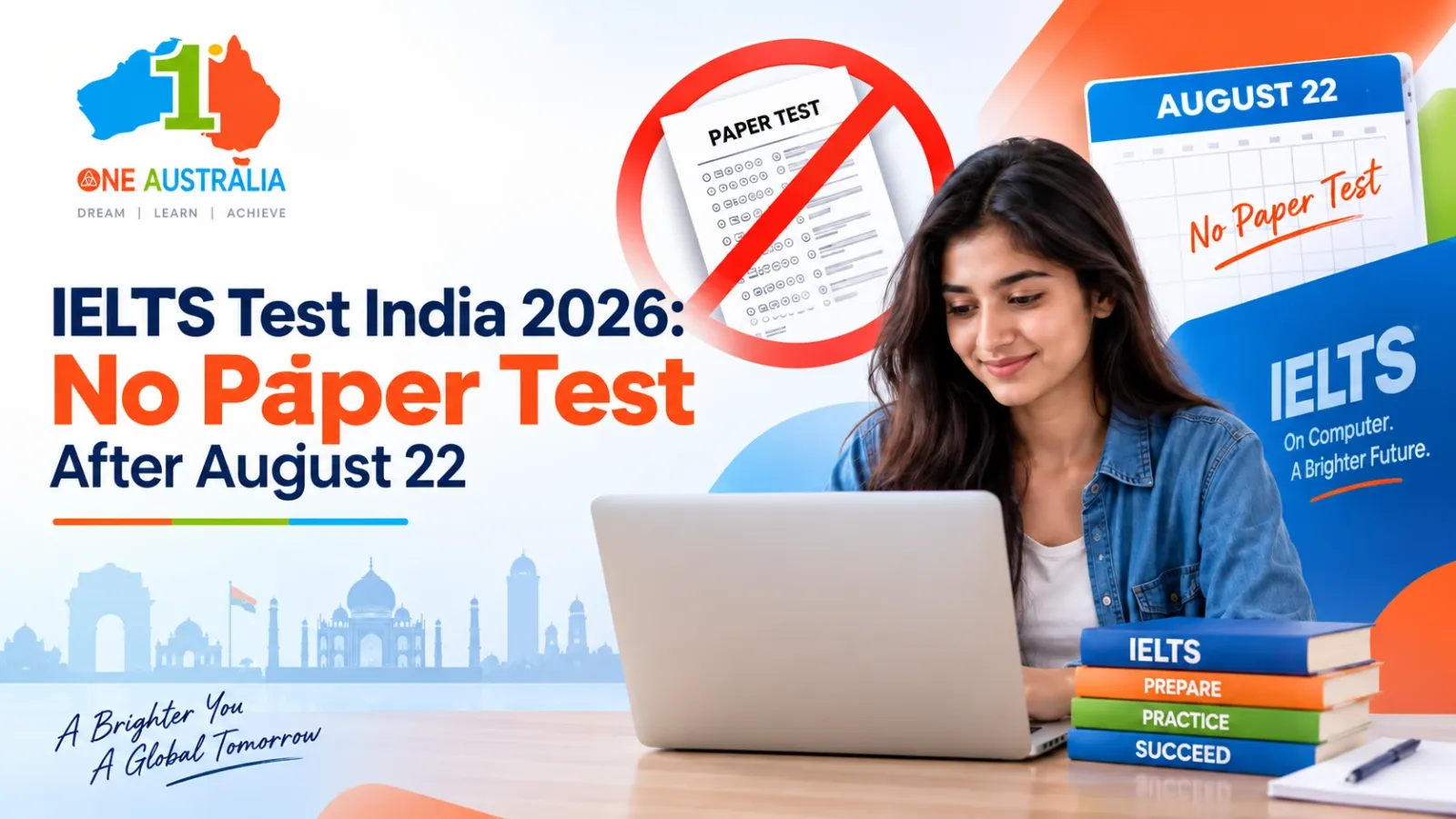
IELTS Academic in India is now computer-only after August 22, 2025, making digital test preparation essential for 2026 candidates.
Paper-based IELTS Academic is no longer available, while General Training remains available in paper format at selected centres.
Band 7+ skilled migration applicants must practise typing, on-screen reading, and timed computer mock tests.
Computer IELTS delivers results in 3–5 days, helping speed up Australian visa applications.
Focused IELTS coaching and computer-based practice can significantly improve your chances of achieving your target score.
If you are preparing for the IELTS test in India right now, there is one change happening in 2026 that most coaching centres are dangerously underplaying. After August 22, 2025, paper-based IELTS Academic tests will no longer be available in India. The IELTS test dates India landscape is being permanently reshaped, and in this analysis, the candidates who treat this as a minor administrative update are the ones who will pay the heaviest price in delayed visas and wasted test fees.
Well, this is not just a format switch. For skilled migration hopefuls targeting Australia, this is a defining moment in their journey. And the window to prepare strategically is narrowing every single week.
Also read,
What the IELTS Test India Change Actually Means (And What Nobody Is Telling You)
The announcement is straightforward enough. From August 22, 2025 onwards, the British Council and IDP will no longer offer paper-based IELTS Academic in India. All Academic test sessions will shift exclusively to the computer-delivered format, also known as IELTS on Computer (IoC).
But here is where we want to push past the headlines, because the data reveals something most coaches miss.
This is not India's first encounter with computer-based IELTS. The format has been available in India since 2018. What changed is that test-takers previously had a choice. That choice is now gone. According to Pearson and IELTS.org data, computer-delivered testing already accounts for over 60% of IELTS sessions globally, and in urban India, uptake had already been climbing sharply before this mandate. So the infrastructure exists. The real issue is candidate psychology and the preparation gap.
The General Training format, used for vocational and general migration purposes, will continue to be offered in both paper and computer formats at select centres. But if you are targeting Australia's skilled migration stream, you are almost certainly sitting the Academic module. And that means the computer format is now your only path.
What does this mean practically?
Your typing speed, your familiarity with an on-screen interface, your ability to read passages off a monitor without fatigue, these are now as important as your English ability itself. In my five years of working with migration-focused IELTS candidates, I have seen strong English speakers underperform on their first computer-based attempt simply because they underestimated the format difference. The test content is identical, but the delivery experience is not.
Why This Change Hits Skilled Migration Candidates the Hardest
Here is the counterintuitive truth: the candidates who should be most concerned about this change are not the ones with weaker English. They are the experienced, high-achieving professionals who have been preparing on paper for months and have built comfort and rhythm around that format.
If you are targeting a Band 7 or above for an Australian skilled migration visa, the stakes are uniquely high. According to Home Affairs data from the Department of Home Affairs (DHA), English language proficiency requirements under the General Skilled Migration (GSM) program are non-negotiable. Applicants for most skilled visas (including the popular Subclass 189, 190, and 491 pathways) need to demonstrate "Proficient English," which typically means an IELTS overall band score of 7, with no individual band below 7 in the Listening, Reading, Writing, and Speaking components.
A single band drop from 7 to 6.5 in one component is not a minor disappointment. It can delay your visa application by six months to a year while you retest and reapply. DHA migration statistics show that English language proficiency failures remain one of the top reasons skilled visa applications are either refused or stalled at the skills assessment stage. Given that Australia's skilled migration intake for the 2024-2025 programme year sits at 185,000 places, competition is real and the margin for error is very thin.
Every day you delay adapting your preparation to the computer format is a day you are practising for a test that no longer exists in India. For candidates planning their IELTS test India preparation, reviewing available IELTS test dates India options is also essential to ensure enough time to adapt to the new format.
OneAustralia Group — Free Demo Class
Ready to hit your target score with a coach who's done this 5,000+ times?
OneAustralia Group has coached 5,000+ students across PTE, IELTS, NAATI CCL, LanguageCert, CELPIP and OET — helping them reach the score they needed for their visa, their career, their family.
📅 Book Your Free Demo Class → oneaustraliagroup.com.au
The Computer vs Paper Difference: A Breakdown Serious Candidates Need to Study
Let us walk you through what actually changes when you shift from paper to computer, because this is where the preparation gap lives.
Feature | Paper-Based IELTS | Computer-Delivered IELTS |
Reading format | Printed booklet | On-screen passages, scrollable |
Writing | Handwritten | Typed on keyboard |
Highlighting/annotating | Pen on paper | On-screen tools (limited) |
Answer transfer (Listening) | 10-min paper transfer | Answers entered directly |
Result turnaround | 13 days | 3 to 5 days |
Test availability | Limited weekly dates | Multiple sessions per week, including weekends |
Test duration | Identical | Identical |
Scoring criteria | Identical | Identical |
Two things in that table deserve particular attention.
First, Writing. In a paper test, your handwriting speed and legibility are part of your working rhythm. On the computer, you are typing. For candidates who are stronger writers but slower typists, this is a skills gap that needs active practice, not passive awareness. In my analysis, this is the single biggest hidden disadvantage for candidates making the switch without proper preparation.
Second, results in 3 to 5 days versus 13 days. This is actually a significant advantage of the new format. For candidates who are racing against visa application deadlines or skills assessment submission windows, faster results mean faster decisions and faster lodgement. If you have been sitting on the fence about when to book, this faster turnaround should push you to act sooner rather than later.
What 5 Years of Test Coaching Has Taught Us About Band 7+ on Computer
The data reveals something most coaches miss when it comes to computer-based IELTS performance: the Reading section is where candidates lose the most ground in their first attempt on a computer, not because the questions are harder, but because on-screen reading is physically and cognitively different from paper reading.
Research in reading comprehension consistently shows that readers scan differently on screens. They tend to skip more, skim faster, and miss embedded detail. For IELTS Academic Reading, where questions are specifically designed to test your ability to locate precise information and follow a writer's argument, this scanning habit is costly.
At One Australia Group, we have worked with hundreds of skilled migration candidates preparing for the IELTS test in India and abroad, and a consistent pattern emerges. Candidates who practise exclusively on paper and then switch to computer on test day lose an average of half to one full band in Reading on their first attempt. That is not a small drop. At the Band 7 threshold, it is the difference between a successful and a failed skills assessment.
The fix is not complicated, but it does require intentional practice. Use official IELTS computer practice tests. Build your screen reading stamina. Learn to use the on-screen highlighting tool deliberately. And time yourself strictly, because the visual rhythm of a screen is different and your internal time sense will shift.
For Writing, practise typing your essays under timed conditions every single week. Aim for at least 250 words for Task 1 and 280 to 300 words for Task 2, not because longer is better, but because you need to build the muscle memory for producing quality, well-structured written output within the time limit on a keyboard.
"I had been preparing for IELTS for almost eight months on paper before I found OneAustralia Group. My speaking and listening were fine, but I kept getting 6.5 in Writing and could not understand why. The team helped me realise I was spending too long on Task 1 and rushing Task 2, and my essay structures were not Academic enough for Band 7. After six weeks of targeted coaching with them, including full computer-based practice tests, I sat my test and got 7.5 overall. My 189 visa application is now lodged and I am counting the days. I honestly do not think I would have made it past the English requirement without their guidance."
> — Priya M., Software Engineer, Hyderabad. Now in Melbourne.
How to Prepare for IELTS Academic on Computer: A Strategic Roadmap
If you are sitting in India and your visa timeline is pushing you toward a test date in 2026, here is the preparation framework that actually works for Band 7+ outcomes.
1. Assess Your Starting Point Honestly
Before you plan anything else, take a full-length, properly timed practice test on a computer, not on paper. Use the official IELTS practice materials from IELTS.org. Score yourself against the official band descriptors. This gives you a baseline that reflects your actual computer-format readiness, which may be different from your paper-based performance.
2. Build a Format-Specific Training Plan
Your preparation should be split between content skill-building (grammar, vocabulary, academic writing structures, reading strategies) and format-specific practice (typing essays, navigating on-screen passages, using the digital interface). Most candidates over-invest in the first and almost completely ignore the second. Both matter.
3. Prioritise Your Weakest Band Component
Because skilled migration visas require no individual band below 7, a weakness in any single skill area is your most urgent problem. Do not average your way to 7. You need 7 in every component. Identify your lowest band from your practice test and build your training schedule around closing that specific gap first.
4. Book Your Test Date Strategically
One genuine advantage of the new computer-based format is the frequency of available test dates. With multiple sessions per week, you have far more flexibility to schedule around your work and family commitments. Book early to secure your preferred slot and work backward from that date to build your study plan.
5. Seek Qualified Coaching Aligned to Migration Outcomes
Generic IELTS coaching is not the same as migration-focused IELTS coaching. Coaches who understand the Australian skilled migration pathway understand what the stakes are, what the scoring thresholds mean for visa categories, and how to help you reach a specific band target efficiently rather than just improving your general English.
The Bottom Line: The Clock Is Running
In my analysis, the August 22 deadline is not just a test format change. It is a signal that the entire IELTS ecosystem in India is maturing toward a digital-first model, and candidates who adapt fastest will be the ones who reach their migration goals soonest.
The candidates I have seen struggle most in this kind of transition are not the ones with the weakest English. They are the ones who keep preparing for the old reality instead of the new one. If you are targeting Australia through the skilled migration stream, your English score is not just a test result. It is a gateway to your visa, your career, your family's future in a country that wants skilled people but demands proof of proficiency.
Do not let a format change be the reason your migration timeline slips by six months or a year. The information is here. The preparation roadmap is clear. What you need now is the right coaching partner who understands both the test and the migration journey behind it.
OneAustralia Group — Free Demo Class
Ready to hit your target score with a coach who's done this 5,000+ times?
OneAustralia Group has coached 5,000+ students across PTE, IELTS, NAATI CCL, LanguageCert, CELPIP and OET — helping them reach the score they needed for their visa, their career, their family.
Frequently Asked Questions About the IELTS Test India 2026 Change
1. Will the scoring criteria change for computer-based IELTS Academic?
No. The scoring criteria, band descriptors, and assessment standards are completely identical between paper and computer formats. Your essay is marked the same way. Your reading answers are assessed the same way. The only difference is the medium of delivery.
2. Can I still take the IELTS on paper in India after August 22, 2026?
No, you can't. August 22, 2026 is the last day for paper-based IELTS in India, confirmed by IDP IELTS India. From September 2026, every test goes fully computer-delivered, though the pattern, scoring and face-to-face Speaking test stay exactly the same.
3. What if I am not comfortable with typing? Will that affect my Writing band score?
Your Writing band score is based on task achievement, coherence and cohesion, lexical resource, and grammatical range and accuracy. Typing speed itself is not a scoring criterion. However, if slow typing prevents you from producing a sufficient volume of writing within the time limit, it will indirectly affect your task achievement and coherence scores. The practical fix is consistent timed typing practice in the weeks before your test.
4. How quickly will I get my IELTS Academic results after the computer test?
Computer-delivered IELTS results are typically available within 3 to 5 days. This is significantly faster than the 13-day turnaround for paper tests, which is a real advantage for candidates working within visa application deadlines.
5. Is the IELTS Academic on computer accepted by Australian immigration authorities and skills assessment bodies?
Yes, completely. The Department of Home Affairs and all Australian skills assessment authorities (including Engineers Australia, VETASSESS, ANMAC, and others) accept computer-delivered IELTS Academic results on exactly the same basis as paper-based results. There is no distinction in how your score is used.