
TL;DR
This guide is for students, graduates and skilled migrants who want to understand what LanguageCert Academic scores mean for university admission and Australian visas.
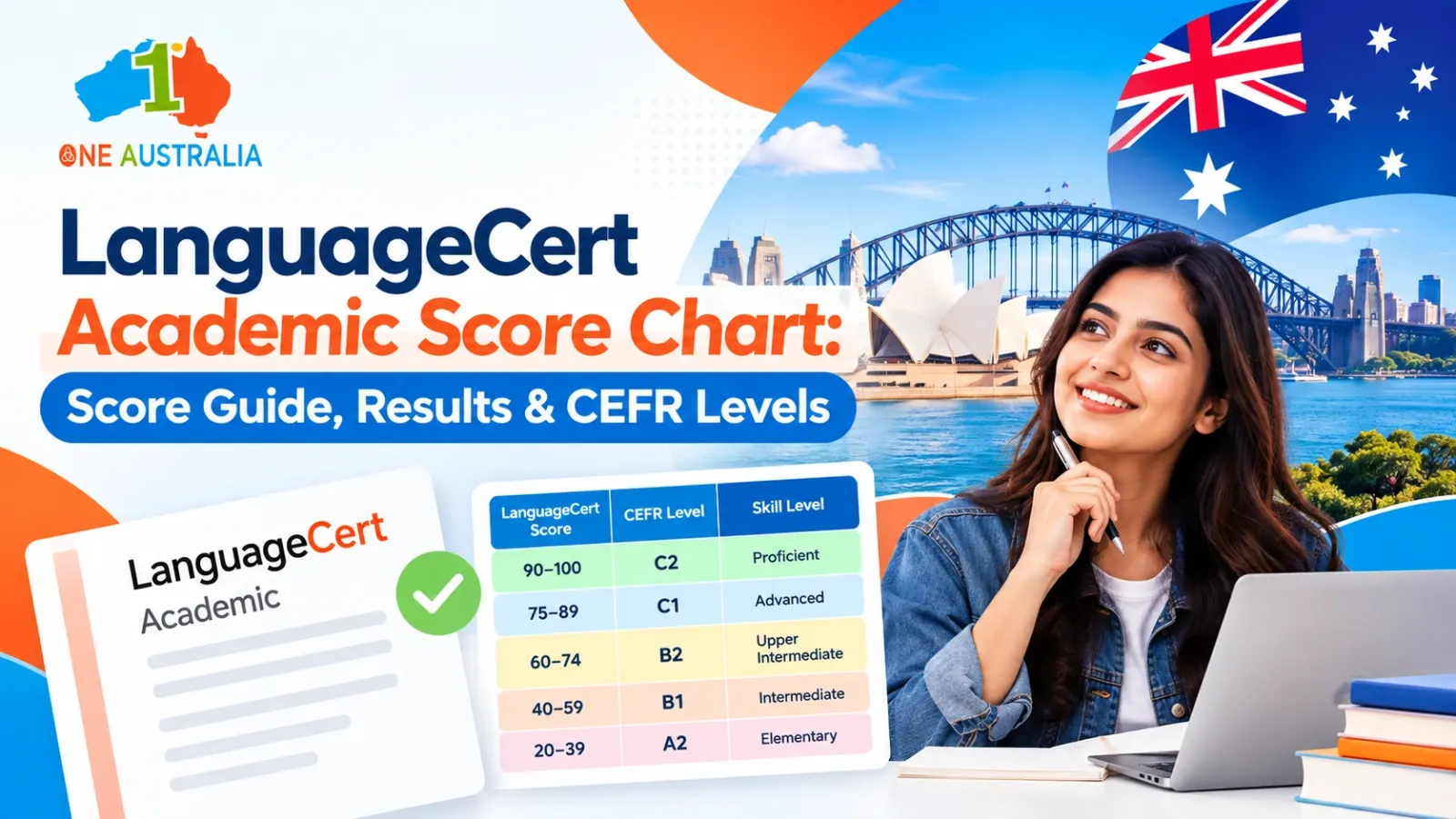
LanguageCert score chart is based on the following scale: 90-100 is C2, 75-89 is C1, 60-74 is B2, 40-59 is B1, with Listening, Reading, Writing and Speaking scores reported separately.
For Australian visas, each English level has a minimum score for each skill. This means a low score in one skill can stop you from reaching a higher English level.
LanguageCert does not expire but Home Affairs requires a visa test result within the previous three years, and only test results from a test centre (secure location) are accepted.
Any LanguageCert Academic score chart comparison to IELTS is for guidance only, and should be based on the official thresholds for each skill.
The LanguageCert Academic score chart shows how scores on the LanguageCert Global Scale (0–100) relate to CEFR levels. Listening, Reading, Writing and Speaking scores are reported separately for each level of LanguageCert Academic, as well as a total score and a corresponding CEFR level. The LanguageCert family of tests have a common scale, meaning that one LanguageCert score chart applies to both Academic and General candidates.
LanguageCert Academic is geared towards higher education. Academic tests are able to measure CEFR levels from B1 to C2, according to Ecctis, an independent UK-based CEFR referencing study. From 7 August 2025, LanguageCert Academic was added to Australia's approved English tests for certain visa purposes. This also made the score chart useful for people planning their migration.
Reading a LanguageCert score chart involves more than simply finding your score in the table. LanguageCert does not use a simple pass-or-fail system. Your individual skill scores matter, and LanguageCert scores cannot be directly converted into IELTS scores. This article explains LanguageCert Academic scores by band, Australian visa requirements, the process of receiving and verifying results, and how to create a study plan based on your target score.
Also Read,
LanguageCert Academic Score Chart at a Glance
The table below is the core LanguageCert score chart. CEFR bands come from LanguageCert Global Scale, which LanguageCert applies across its tests. The IELTS column shows commonly used comparisons for university entry. However, each institution can set its own score requirements.
LanguageCert Academic score | CEFR level | What level signals | Indicative IELTS Academic |
90 100 | C2 | Near native command of demanding academic and professional English | 8.5 9.0 |
75 89 | C1 | Advanced, flexible English for study and professional work | 7.0 8.0 |
60 74 | B2 | Independent user, comfortable in most academic and workplace situations | 5.5 6.5 |
40 59 | B1 | Intermediate user, copes with familiar topics and routine tasks | 4.0 5.0 |
20 39 | A2 | Basic user | Not usually compared |
10 19 | A1 | Beginner | Not usually compared |
0 9 | Below A1 | No CEFR level awarded | Not usually compared |
LanguageCert Academic is designed to assess CEFR levels from B1 to C2. The chart also includes lower score ranges because the Global Scale is shared across LanguageCert tests. These lower ranges do not mean that the Academic test officially assesses lower CEFR levels. The lower score ranges are included to provide more detail for people who receive scores in that range
There's one more thing to be considered. The score chart shows the CEFR bands, but decisions are often based on individual skill scores. For example, your overall score could be C1 while your Speaking score is B2. A visa or university requirement may look at the Speaking score separately
How LanguageCert Global Scale Works
Each skill is rated on a scale of 1–100. The results are accompanied by a total score and a CEFR level, so the Test Report provides a performance profile rather than a single grade.
LanguageCert does not use a single pass-or-fail score. Instead, candidates receive scores for individual skills, along with a total score and CEFR level. LanguageCert scores give more detail about your performance. The organisation receiving your result can then decide whether your scores meet its requirements. That's the design that makes it logical that universities, employers and the Australian government can each request a different number from the same test.
LanguageCert's scale is linked to the CEFR. LanguageCert also reviews test performance and research to make sure the scoring remains reliable. If you want more technical information, the LanguageCert website explains the Global Scale and its comparison with IELTS Academic.
If the test itself is still unfamiliar, guide to what LanguageCert Academic is covers the basics, and the LanguageCert Academic exam format, fees and preparation tips article covers the paper in more detail.
LanguageCert Academic Score by CEFR Level
Each CEFR band on LanguageCert Academic score chart describes a different kind of English user. Knowing what sits behind numbers helps in judging whether a target is realistic.
B1 (40 59): Intermediate
A B1 candidate can understand what happens in familiar situations, describe an experience or a plan in simple terms and respond to straightforward speech about familiar topics. Academic reading and structured essay writing may still be difficult at this level. This level may not meet the requirements for many degree programs or skilled visas. However, whether B1-level performance meets a particular visa requirement depends on the specific visa and the required English level.
B2 (60 74): Upper Intermediate
At B2, English users can generally: follow main ideas in complex texts, participate in discussion without extensive word searches, and provide clear, detailed responses. B2 is an important level for many test takers. For Australian visas, the Competent English level requires different minimum scores in the four skills: 57 in Listening, 60 in Reading, 64 in Writing and 70 in Speaking.
C1 (75 89): Advanced
C1 candidates can use English confidently for study and professional work. They understand longer, demanding material, pick up implied meaning and organise ideas in writing without obvious effort. A strong LanguageCert Academic score in this band may meet the English-language requirements for some postgraduate courses, depending on the institution and program, and it is where Writing and Speaking requirements for Proficient and Superior English begin.
C2 (90 100): Near Native
C2 users can understand demanding language, including subtle differences in meaning, very fast speech and idiomatic expressions. Very few candidates achieve the level in all four skills. C2 is not normally required for most purposes, but it represents the highest CEFR level on the LanguageCert scale.
LanguageCert Academic Score Requirements for Australian Visas
From 7 August 2025, Home Affairs has accepted LanguageCert Academic for certain visas that require proof of English, when the test is taken at a secure test centre. Academic Online, at home version is not valid for Australian visa applications. The table below sets out the minimum LanguageCert Academic scores required in each skill across each English level for Australian visas, n line with the relevant Home Affairs requirements. LanguageCert has published these minimum scores, which are based on the relevant Home Affairs requirements.
English level | Listening | Reading | Writing | Speaking |
Functional | 38 overall score | 38 overall score | 38 overall score | 38 overall score |
Vocational | 41 | 44 | 45 | 54 |
Competent | 57 | 60 | 64 | 70 |
Proficient | 67 | 71 | 78 | 82 |
Superior | 80 | 83 | 89 | 89 |
There are two patterns that are evident when reading this table against the LanguageCert score chart. At all levels starting at Vocational, both Speaking and Writing have the highest threshold, and are most likely to determine whether or not a level is achieved. Second, C2 is not a requirement for Superior English. Writing/Speaking at or above 89 is very top of C1 band, slightly less than C2 band (90).
How Points Work
Competent English is required for certain skilled visas, such as subclasses 189, 190 and 491, but it does not give you extra points. Proficient English gives 10 points, while Superior English gives 20 points. For general guidance, LanguageCert publishes indicative comparisons with IELTS Academic. However, these comparisons should not be treated as direct score conversions or as evidence that a particular institution will accept the scores as equivalent.
Each English level has a minimum score requirement for the individual skills. Your overall score alone does not determine whether you meet the Competent, Proficient or Superior English requirements. Check the minimum score for each skill separately.
A Worked Example
Hypothetical candidates are Listening 74, Reading 76, Writing 80 and Speaking 79. These scores meet the Competent English requirements in all four skills. Against Proficient row, Listening (67), Reading (71) and Writing (78) all pass, but Speaking is below 82 by three points. The candidate meets Competent English, but does not meet the Proficient English threshold because the Speaking score is below the required minimum. As a result, the candidate would not receive the additional points associated with Proficient English.
The score chart helps you understand your English level. The gap in Speaking is small, so focused speaking practice may help improve the score.
Student Visas and Timing Rules
Student visa thresholds are set separately from skilled visa levels. Student visa English requirements are separate from the skilled-migration English levels. The applicable minimum score depends on the visa stream and the applicant's circumstances, so candidates should check the current Department of Home Affairs requirements before booking a test.
Timing also matters. For Australian visas, Home Affairs generally requires an English test result from within the previous three years. You may also need to provide your Test Report with your application. A guide on whether LanguageCert is accepted in Australia explains acceptance in more depth, and a competent English guide covers how that level works across tests.
What Counts as a Good LanguageCert Academic Score?
A good score is one that meets the requirement and gives you a small safety margin. No single standard exists since there are many types of courses such as nursing programs, business degrees, and work visas that have their own requirements.
The relevant score requirement is usually available on the university or institution's official website. Many universities list their English requirements by CEFR level. You can use the LanguageCert score chart to see the score range for B2 or C1. However, each institution may have its own requirements.
For migration, the requirements are more specific. Competent English is a basic level; Proficient English provides 10 points for eligible skilled-migration purposes, while Superior English provides 20 points. If you are close to the required score in each skill, you may want to consider taking the test again. A small difference in one skill can affect your result.
Aim for a few points above the minimum requirement when possible. This gives you a small safety margin. Performance of test day is variable; an exact score would not allow for any weakness during speaking or writing sessions.
Reading Your LanguageCert Academic Results
Your LanguageCert Academic Test Report shows your scores for the four skills in one report. After receiving it, you can see on the languagecert scores chart what level of CEFR is for this particular skill. LanguageCert indicates that results are generally available within approximately five working days, although processing times can vary depending on the test and delivery method. Candidates should check the current result-processing information when booking.
The institution or an immigration officer may verify this document by using languagecert test reports verification services that require information such as age at time of application, applicant ID number and unique reference numbers from documents like passports etc. Verification may require details from the candidate's Test Report and identification documents.
Candidates who believe a score does not reflect their performance can ask about Enquiry on Results service. fee and time window change, so check current terms on LanguageCert website before relying on it. For a booking walkthrough, see step by step guide to booking your LanguageCert test.
Does a LanguageCert Academic Score Expire?
According to LanguageCert, there is no expiration date for their products/services. However, this does not mean that every organisation will accept an older result indefinitely. For Australian visa purposes, Home Affairs generally requires an English test result from within the relevant validity period. Universities, employers and other organisations may apply their own policies regarding how recent a result must be. It would be more reasonable if we schedule our tests according to when an application will arrive rather than on a specific day of certification.
Using Chart to Raise Your Score
The most effective study plan begins at a low point then moves up to it. Select an appropriate level of difficulty for this task; list at least four skills below that you need to improve upon by taking a timed practice test so we can find out what your current proficiency is like on those items. Difference of scores from practice to targets on skills are an actual research paper.
Talking and writing have more importance than listening to reading as they require higher levels while speaking/writing has lower threshold compared to these two activities. Listening is scored at least two points below its mark while speaking scores are given 20 marks above that of listening.
Speaking involves taking notes on what you say while also listening for pauses, repetitions of certain phrases or sentences that are difficult to understand. Writing aims at being an ideal solution for completing assignments prior to writing starts and editing during deadlines. Note-taking helps improve listening skills through practicing various audio files while reading is better if it involves finding out information more efficiently instead of reading each word aloud.
Timed mock tests turn LanguageCert score chart into a feedback loop. Each attempt produces four numbers that can be compared against the target row, and pattern across several attempts is more reliable than any single result. Candidates can start with a free LanguageCert mock test and compare outcomes with thresholds above.
Candidates who are still choosing between exams can compare LanguageCert Academic and IELTS options, or review LanguageCert and PTE comparison. PTE score chart and IELTS band score guide show how other major tests are scaled.
Common Mistakes When Reading a LanguageCert Score Chart
Firstly, treat this like a standard translation service rather than an official conversion tool for IELTS scores. Recommended links between languages-certification; common pairings such as this can be helpful for students' purposes, however they're decided by individual universities or departments of their choice rather than being standardized across all institutions like those set out by IELTS standards.
The second mistake is planning around the overall score. A fantastically large amount of visas may mask poor skills at other points within them. Third is booking the wrong delivery mode, since LanguageCert Academic Online is not accepted by Home Affairs and a result from it cannot be used for a visa.
Last Mistake Is Leaving Dates To Chance. The results from LanguageCert might not be current enough for an immigration application, and scores obtained earlier than a skilled visa offer could have to be updated.
Setting a Target Score
The LanguageCert academic grade scale is precise. Knowledge about requirements, four skills minimums, acceptance criteria for testing centers' rules and time frame allow you to take an individual exam without worrying about repeating it due to poor scores.
Most of them are decided by an easy choice from many options available for their application process. Visa levels to confirm; copies of four threshold tests done on examination day; closing gaps by weakest skills first. The language certification scores are tracked by a Progress Tracker where each test result indicates how much closer it is to its goal.
Students and migrants preparing for tests can work with a team that builds study plans around these exact thresholds. One Australia Group offers LanguageCert Academic coaching with skill by skill feedback, and a free mock test is a good first step toward a realistic target.
FAQs
Q: What is a good LanguageCert Academic score?
It depends on purpose. For Australian skilled visas, a score that meets Competent thresholds (57, 60, 64 and 70) is baseline, while Proficient (67, 71, 78 and 82) and Superior (80, 83, 89 and 89) earn 10 and 20 points. For university entry, the course page of the institution gives figures that matter.
Q: What is a LanguageCert 75 in IELTS?
A LanguageCert Academic score of 75 is bottom of C1 band and is commonly paired with IELTS Academic 7.0. This is a guide rather than an official conversion, so universities and visa authorities may apply their own cut offs.
Q: Did the LanguageCert Academic test pass or fail?
No. LanguageCert reports a score for each skill, a total score and a CEFR level, and the organisation receiving the result decides whether numbers are high enough. That is why the LanguageCert score chart is used to read results, not to declare a pass.
Q: How long does it take to get LanguageCert Academic results?
LanguageCert indicates around five working days for Academic test, though timing can vary by delivery mode and test centre. Results appear in a Test Report on the candidate's online account.
Q: How long is a LanguageCert Academic score valid?
LanguageCert says its results and certificates do not expire. For Australian visas, Home Affairs generally expects a result from three years before application, so the LanguageCert Academic score chart tells you what the number means, but application rules decide whether the result is still usable.
Q: Can LanguageCert Academic Online be used for an Australian visa?
No. Home Affairs does not accept tests delivered completely online or at home, and LanguageCert Academic Online is on its list of excluded tests. Candidates need to book LanguageCert Academic at a secure test centre.