TL;DR
This blog is designed for international students, study abroad applicants, university admission seekers, visa applicants, and English test candidates comparing TOEFL with IELTS or PTE. It explains everything from TOEFL meaning, exam types, new 2026 format changes, scoring system, Australian visa considerations, and preparation strategies.
Learn the meaning of TOEFL (Test of English as a Foreign Language), how it evaluates academic English skills, who needs to take the TOEFL exam, and why universities worldwide accept TOEFL scores.
Discover the latest TOEFL iBT changes, including the shorter adaptive test structure, new Reading, Listening, Speaking, and Writing tasks, updated scoring scale, and how the exam differs from the previous format.
Explore TOEFL iBT, TOEFL Essentials, and TOEFL ITP, understand the new 1–6 scoring system, score requirements, and compare TOEFL with IELTS and PTE to choose the right English proficiency test.
Get practical preparation tips, common mistakes to avoid, registration guidance, Australian visa considerations, and strategies to achieve your target TOEFL score in 2026.
Also Read
Is TOEFL Accepted in Australia for PR? 2026 Guide & DHA Rules
PTE Result Time: Full Timeline & What It Means for PR | One Australia Group
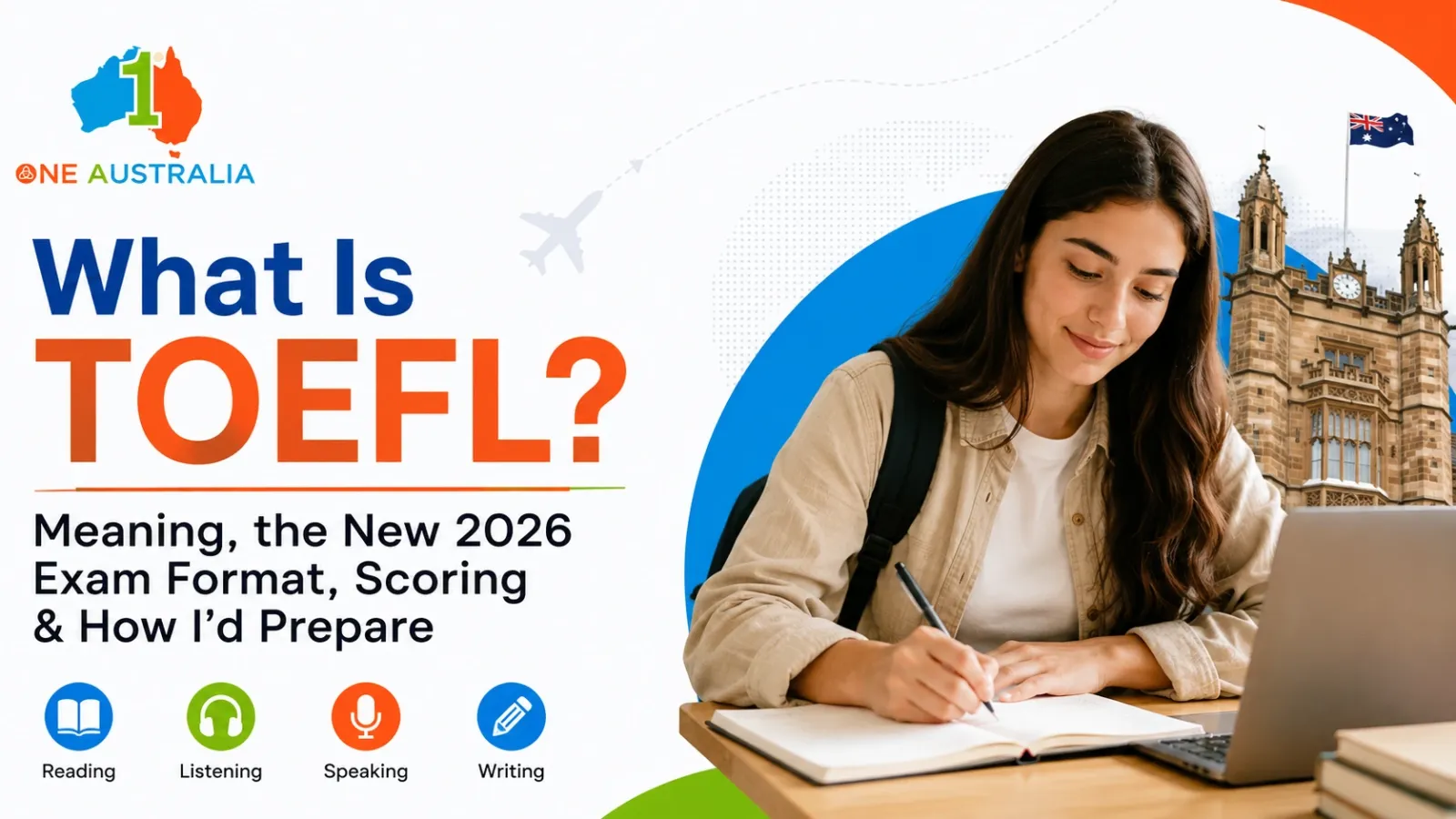
TOEFL (Test of English as a Foreign Language) is ETS's academic English exam. From January 21, 2026, the TOEFL iBT introduced major updates, including a shorter test experience, adaptive Reading and Listening sections, and a new 1–6 scoring scale alongside the previous 0–120 score reporting. If you're comparing it to IELTS or PTE for an Australian visa, that changes your calculation too, and I'll show you exactly how.
I coach English-test candidates for a living mostly people preparing for PTE and IELTS ahead of an Australian visa or university offer and TOEFL is the exam I get asked about most without actually teaching. Students ask "what is the TOEFL test, and should I take it instead?" almost every week. So I've pulled together everything I tell them, including the parts most guides still get wrong because they haven't been updated since ETS overhauled the exam this year.
What Is TOEFL?
TOEFL stands for Test of English as a Foreign Language. It's a standardized exam, owned and administered by ETS (Educational Testing Service), that measures how well a non-native speaker can read, listen, speak, and write in English at a university level.
That's the TOEFL meaning in one sentence: it's not a general fluency test like a casual conversation quiz, it's built specifically to predict whether you can survive a lecture hall, a seminar discussion, and an essay deadline in English. ETS has run it since 1964, and today, more than 13,000 institutions across over 200 countries accept TOEFL scores for academic admissions and other English proficiency requirements.
The version almost everyone means when they say "TOEFL" is the TOEFL iBT (internet-based test). You can sit it at an authorised test centre or, for most purposes other than an Australian visa (more on that below), from home under live remote proctoring.
What Does TOEFL Stand For? (TOEFL Meaning, Explained Properly)
TOEFL means Test of English as a Foreign Language but I find students remember it better once they understand why each word is there:
Test it's scored and standardized, not a casual interview.
English specifically English, as opposed to sister products like the TOEIC (workplace English) or the Michigan English Test.
as a Foreign Language it's built for people who learned English as an additional language, not native speakers.
So when someone asks "toefl means what, exactly," the honest answer is: it means you're proving your academic English is strong enough to study, work, or migrate in an English-speaking environment nothing more mysterious than that.
Types of TOEFL Tests Explained: TOEFL iBT, TOEFL Essentials & TOEFL ITP
When planning to take the TOEFL exam, it is important to understand that there are different types of TOEFL tests designed for different purposes. While most students are familiar with the TOEFL iBT, ETS offers different TOEFL-related assessments, including TOEFL iBT, TOEFL Essentials, and TOEFL ITP, although TOEFL iBT remains the primary test used for international university admissions.
Choosing the right TOEFL English proficiency test depends on your goal, such as studying abroad, meeting university admission requirements, or completing an institutional English assessment.
1. TOEFL iBT (Internet-Based Test)
The TOEFL iBT is the most popular and widely accepted TOEFL test for international students who want to study abroad. It is primarily used for university admissions, academic programs, scholarships, and English language requirements.
The TOEFL iBT exam measures your ability to communicate effectively in an academic environment through four sections:
Reading
Listening
Speaking
Writing
Unlike general English tests, the TOEFL iBT test format focuses on real academic situations, such as understanding university lectures, participating in classroom discussions, and writing academic responses.
Key Features of TOEFL iBT:
Accepted by universities and institutions worldwide
Designed mainly for students applying for undergraduate and postgraduate programs
Available at authorised test centres and as a TOEFL Home Edition in eligible locations
Tests academic English skills required for university success
Provides internationally recognised TOEFL scores
Who Should Take TOEFL iBT?
The TOEFL iBT exam is suitable for:
Students applying to universities overseas
International students meeting English admission requirements
Candidates applying for scholarships
Students who need proof of English proficiency for academic purposes
2. TOEFL Essentials Test
The TOEFL Essentials Test is a shorter and more flexible TOEFL English test designed to evaluate both academic English and everyday communication skills.
Compared with the TOEFL iBT, the TOEFL Essentials exam includes questions based on real-world situations along with academic contexts, making it a broader assessment of English ability.
Key Features of TOEFL Essentials:
Shorter test duration compared with TOEFL iBT
Measures Reading, Listening, Speaking, and Writing skills
Includes academic and everyday English tasks
Available as an online test with remote proctoring
Suitable for students looking for a flexible TOEFL exam option
Who Should Take TOEFL Essentials?
The TOEFL Essentials Test may be suitable for:
Students looking for a shorter English proficiency assessment
Candidates applying to institutions that accept TOEFL Essentials scores
Test takers who prefer a combination of academic and daily English questions
3. TOEFL ITP (Institutional Testing Program)
The TOEFL ITP is an institutional English assessment used by schools, universities, and organisations to measure students' English language ability.
Unlike the TOEFL iBT for university admission, TOEFL ITP is mainly used internally by educational institutions and is generally not intended for immigration or international university applications.
Key Features of TOEFL ITP:
Conducted by educational institutions
Used for internal English evaluation
Measures Listening, Reading, and language structure skills
Available in paper-based and digital formats
Helps institutions assess student progress and English proficiency levels
Who Should Take TOEFL ITP?
The TOEFL ITP exam is commonly used by:
Universities conducting English placement tests
Students enrolled in institutional English programs
Organisations evaluating English skills internally
TOEFL Test Types Comparison
Feature | TOEFL iBT | TOEFL Essentials | TOEFL ITP |
Main Purpose | University admission and study abroad | Academic + everyday English assessment | Institutional English assessment |
Best For | International students | Flexible English testing | Internal university programs |
Skills Tested | Reading, Listening, Speaking, Writing | Reading, Listening, Speaking, Writing | Listening, Reading, Structure |
Test Format | Computer-based | Online with remote monitoring | Paper or digital |
Accepted Worldwide | Yes | Depends on institution | Limited acceptance |
Which TOEFL Test Should You Take?
For most students planning to study abroad, the TOEFL iBT exam is the best choice because it is the main TOEFL test accepted by universities worldwide.
Students should choose the TOEFL test type based on their goals:
Choose TOEFL iBT → If you need TOEFL scores for university admission or academic programs.
Choose TOEFL Essentials → If you want a shorter TOEFL English proficiency test that evaluates both academic and everyday communication.
Choose TOEFL ITP → If your school or organisation requires an internal English assessment.
Understanding the different TOEFL test types before starting your TOEFL preparation helps you select the right exam and avoid preparing for the wrong test format.
Who Actually Needs to Take the TOEFL?
Not everyone applying abroad needs it and I've seen students waste a study season prepping for the wrong test. Here's who genuinely does:
University applicants
If you're applying to an undergraduate or graduate program taught in English most commonly in the US, but also Canada and parts of Europe and Asia, TOEFL is one of the standard proof points admissions offices ask for.
Visa and immigration applicants
Some immigration pathways in the US, Canada, and Australia accept TOEFL scores as evidence of English proficiency, though as I'll get into in the Australia section it's rarely the first choice locally.
Healthcare and licensing candidates
Nurses, pharmacists, and other medical professionals sometimes need an English score for registration in English-speaking countries, alongside or instead of exams like OET.
Employees at English-medium employers
International companies operating in English sometimes ask job applicants for a TOEFL score as part of hiring.
One practical note I give every student: check with the specific institution or visa stream before committing. Some universities waive the requirement if you studied in English for several years, and some Australian visa pathways only accept certain tests taken a certain way which is exactly the gap I want to fix in this guide.
What Changed in the TOEFL Exam Format for 2026?
This is the part that almost every other "what is TOEFL" article online gets wrong right now, because it hasn't been updated. On January 21, 2026, ETS rolled out the biggest TOEFL redesign since 2005, and if you're prepping from an older guide or a secondhand textbook, you're studying for a test that no longer exists.
Here's what actually changed:
Feature | Old TOEFL iBT (pre-2026) | New TOEFL iBT (from Jan 21, 2026) |
Total test time | ~2 hours (previously up to 3 hours) | ~1.5 hours |
Reading & Listening | Fixed difficulty for everyone | Multistage adaptive difficulty adjusts to your performance |
Content type | Almost entirely academic | Mix of academic content and everyday campus/real-life material |
Scoring scale | 0–120 only | New 1.0–6.0 CEFR-aligned band scale, with legacy 0–120 shown alongside through 2028 |
Speaking tasks | 4 tasks (independent + integrated) | 2 new tasks: "Listen and Repeat" and "Interview" |
Writing tasks | Long integrated essay + independent essay | "Build a Sentence," "Write an Email," and an Academic Discussion task |
Scheduled break | 10-minute break included | No scheduled break |
Score delivery | 4–8 days | As fast as 72 hours |
A few things worth flagging that I haven't seen covered elsewhere: ETS also reordered the sections the sequence is now Reading, then Listening, then Writing, then Speaking, which is a swap from the old Speaking-before-Writing order. And the Reading section now includes "Complete the Words" fill-in tasks, while Listening includes a new "Choose a Response" task where you pick the natural reply to a short spoken prompt both designed to test practical, real-world English rather than only textbook academic English.
If your target university or visa pathway published its TOEFL requirement before January 2026, don't panic ETS has confirmed all previously accepted score thresholds carry over; institutions are simply seeing a new band alongside the familiar number during the transition period.
What's on the TOEFL Test? (Section-by-Section Breakdown)
Here's what the current TOEFL exam pattern actually looks like:
Section | Duration | What You Do | Adaptive? |
Reading | ~30 min | Academic passages plus daily-life texts (emails, notices); up to 50 items including "Complete the Words" tasks | Yes |
Listening | ~29 min | Short conversations and academic talks; up to 47 items including "Choose a Response" tasks | Yes |
Writing | ~23 min | "Build a Sentence," "Write an Email," and an academic discussion response | No |
Speaking | ~8 min | "Listen and Repeat" and "Interview"-style tasks, recorded via your computer mic | No |
Reading tests whether you can pull out main ideas, details, and vocabulary from both academic and everyday English. Listening checks comprehension of both lectures and casual spoken exchanges. Writing has moved away from the old 300-word essay format toward shorter, more functional tasks: you're building sentences and drafting a professional email as much as arguing a position. Speaking is now built entirely around spontaneous, real-time response rather than memorised templates, which is a genuine shift from how TOEFL speaking used to be coached.
How Is the TOEFL Scored in 2026?
TOEFL scoring works on two scales right now, shown side by side on every score report through 2028:
New Band Scale (1.0–6.0) | Legacy Scale (0–120) | Proficiency Level (CEFR) |
5.5–6.0 | 114+ | Advanced (C2) |
4.5–5.0 | 95–106 | Advanced (C1) |
3.5–4.5 | 72–94 | Upper-Intermediate (B2) |
3.0–3.5 | 60–71 | Intermediate (B1) |
Below 3.0 | Below 60 | Developing |
Your overall score is the average of your four section scores, each scored in half-point increments (3.0, 3.5, and so on). If you sit the test more than once within two years, ETS's "MyBest" scores let you combine your highest section results across attempts so a strong Reading score from March and a strong Speaking score from May can both count toward your best composite report.
There's no universal pass or fail. Each institution sets its own minimum, so "what's a good TOEFL score" genuinely depends on where you're applying. Competitive programs often want 4.5+ (95+ legacy), while many undergraduate programs sit closer to 4.0 (80+ legacy).
Is TOEFL Harder Than IELTS or PTE?
This is genuinely the question I get most, and the honest answer is: it depends on how you personally process English, not on which test is objectively harder.
Factor | TOEFL iBT | IELTS | PTE Academic |
Format | Fully computer-based | Paper or computer | Fully computer-based |
Speaking | Recorded, to a computer | Face-to-face with an examiner | Recorded, AI-scored |
Scoring | 1–6 band (new) / 0–120 (legacy) | 1–9 band | 10–90 scale |
Total time | ~1.5 hours | ~2 hours 45 minutes | ~2 hours |
Most accepted in | US, Canada | UK, Australia, NZ, Canada | Australia, UK, Canada, NZ |
Result speed | As fast as 72 hours | 3–13 days | Typically 24–48 hours |
If you're more comfortable talking to a screen than a person, TOEFL and PTE both suit you better than IELTS. If you'd rather have a real conversation with an examiner and you want the safety net of IELTS's One Skill Retake, which lets you resit a single section instead of the whole exam, IELTS is the more forgiving choice. From what I see coaching PTE and IELTS candidates specifically, most people find PTE's algorithmic scoring more predictable to train for than TOEFL's more traditional academic format, largely because PTE's integrated tasks let strong skills compensate for weaker ones more directly.
If you want to see where you actually land before committing to a study plan, our free TOEFL iBT mock test gives you a benchmark score under real exam conditions, and you can compare that against a free PTE Academic mock test or free IELTS Academic mock test to see which format actually plays to your strengths.
Does TOEFL Work for an Australian Visa or PR?
This is the question none of the standard "what is TOEFL" guides answer, and it matters a lot if you're reading this from Australia or planning to migrate here.
TOEFL iBT is accepted for eligible Australian visa purposes when taken under approved conditions. However, IELTS and PTE are more commonly chosen among Australian migration applicants due to their widespread use and preparation availability.
A few things I make sure every student understands:
The TOEFL Home Edition is not accepted for Australian skilled migration visas. You must sit the in-centre TOEFL iBT the at-home version, while fine for most university applications, doesn't count for visa purposes. This trips people up constantly, because the Home Edition is heavily marketed as the convenient option.
TOEFL's scoring structure makes it harder to target a specific visa threshold. Australian points-based visas increasingly assess English at the individual skill level (listening, reading, writing, speaking) rather than just an overall score. IELTS and PTE were both built with this kind of per-skill reporting in mind from the start; TOEFL's traditional academic format and total-score emphasis make it a less natural fit.
Healthcare registration bodies like AHPRA typically don't accept TOEFL at all; they usually mandate IELTS Academic or OET specifically, regardless of what the visa itself accepts.
Market share matters practically, even if it isn't official policy. Because PTE and IELTS dominate in Australia, more local test centres, more coaching support, and more institution-specific guidance exists for those two which is part of why most of the migration candidates I work with end up choosing one of them over TOEFL, even though TOEFL remains valid.
If you're US-bound for university, TOEFL is often the more natural, more widely recognised choice. If you're specifically chasing an Australian visa or PR, I'd genuinely encourage you to compare your likely PTE Academic score or IELTS band against the TOEFL equivalent before locking in a study plan for most Australia-bound applicants, one of those two ends up being the faster path to the score you actually need. Always confirm current requirements directly with the Department of Home Affairs before booking, since visa English requirements are reviewed periodically.
Skimmable summary: TOEFL iBT is accepted for most Australian skilled migration visas, but the Home Edition is not needed for the in-centre version. TOEFL also has smaller local market share and less per-skill flexibility than IELTS or PTE, which is why most Australia-bound applicants I coach end up choosing one of those two instead.
How Much Does TOEFL Cost, and How Do I Register?
TOEFL registration fees vary by country except somewhere in the $173 to $475 USD range depending on where you sit the test, plus extra for late registration (roughly US $40 to $49), rescheduling, or additional score reports beyond the four free ones included at registration.
Registering is straightforward:
Create an ETS account at ets.org.
Choose your test option test centre (required for most Australian visa purposes) or Home Edition.
Pick a date and location, ideally 3–4 months ahead during busy application seasons.
Pay the registration fee and select up to four free score recipients.
Get your confirmation email with test-day details.
Sit the test, then receive your score as quickly as 72 hours later.
How Should You Prepare for TOEFL?
I'll be honest with you: the biggest mistake I see is students studying from material that predates January 2026. If your prep book, app, or course doesn't specifically mention the adaptive format and the new task types, it's teaching you to prepare for a test that no longer exists.
Here's the study approach I'd actually recommend, whether you're self-studying or working with a tutor:
Sit a diagnostic test first. You need a real baseline before you can build a study plan: a full mock under timed, adaptive conditions tells you far more than a section-by-section guess.
Get specific about your target score, in both the new band and the legacy 0–120 equivalent, based on your actual program or visa requirement, not a generic "good score."
Drill the new task types deliberately. "Listen and Repeat" and the Interview task reward spontaneity over memorised templates; "Build a Sentence" and email writing reward precision over length. Practising old-format essay writing won't transfer well to these.
Build daily academic vocabulary and everyday English in parallel since Reading and Listening now blend both, reading only textbooks (or only casual content) will leave a gap.
Simulate real exam conditions at least once before test day, including the fact that there's no scheduled break anymore. Stamina management now matters differently than it used to.
Review every practice attempt for patterns, not just scores. A wrong answer that repeats a mistake type is worth more diagnostic information than three random misses.
Most test-takers need somewhere between a few focused weeks (if you're already close to your target) and three months (if you need a meaningful jump), depending on your starting level and how many points you need to gain.
Frequently Asked Questions
What does TOEFL stand for?
TOEFL stands for Test of English as a Foreign Language. I find it helps to remember it's specifically about academic English proficiency for non-native speakers, not general conversational fluency. That's the distinction that trips people up when they compare it to something like a workplace English test.
What does the TOEFL exam meaning in practice? What does a good score actually prove?
In practice, a strong TOEFL score tells an admissions officer or visa assessor that you can follow a university lecture, read academic material at speed, hold a real-time spoken exchange, and produce clear written English under time pressure. I've seen students with excellent conversational English still need real prep here, because the academic-context demands are genuinely different from everyday fluency.
How long is the TOEFL now?
As of January 2026, the TOEFL iBT takes about 1.5 hours to complete, down from roughly two hours previously. There's no scheduled break built into the new format, so I always tell students to plan their energy accordingly on test day.
Is the new 2026 TOEFL harder than the old one?
Not inherently it's different rather than harder. The adaptive Reading and Listening sections mean the test calibrates to your actual level rather than throwing the same fixed-difficulty questions at everyone, which some students find fairer. The trade-off is that older prep material, including books and practice tests from before 2026, won't accurately reflect what you'll face.
Do I need TOEFL if I'm applying for an Australian visa?
Not necessarily TOEFL iBT (in-centre only, not the Home Edition) is accepted for most Australian skilled migration visas, but IELTS and PTE are far more commonly used locally and, for most applicants I coach, easier to target at the per-skill level Australian visas now assess. I'd always recommend comparing your likely score across tests with a free mock before committing.
How much does TOEFL cost, and is it more expensive than IELTS or PTE?
TOEFL runs roughly $185–$325 USD depending on your country, which is broadly comparable to IELTS and PTE once you factor in regional pricing differences for each. The bigger cost consideration, in my experience, is usually retake fees if you choose a test format that doesn't suit your strengths which is why I push students toward a diagnostic mock test before spending on registration.
How long are TOEFL scores valid?
TOEFL scores are valid for two years from your test date. After that, they expire and can no longer be sent to institutions, so time your test relative to your application deadlines with that window in mind.